

Male circumcision often sits at the intersection of sex, culture, religion, medicine, and personal history. For LGBTQ+ people, the topic can carry added weight because it touches bodies, pleasure, health risk, identity, and choice. The evidence is broad, sometimes misused, and often flattened into slogans. This piece aims to slow things down and focus on what is known, what is debated, and what matters in practice.
What male circumcision is
Male circumcision is the surgical removal of the foreskin from the penis. It may occur in infancy, childhood, adolescence, or adulthood. The reasons vary. Some are religious. Some are cultural. Some are medical. Some are personal.
How common circumcision is worldwide
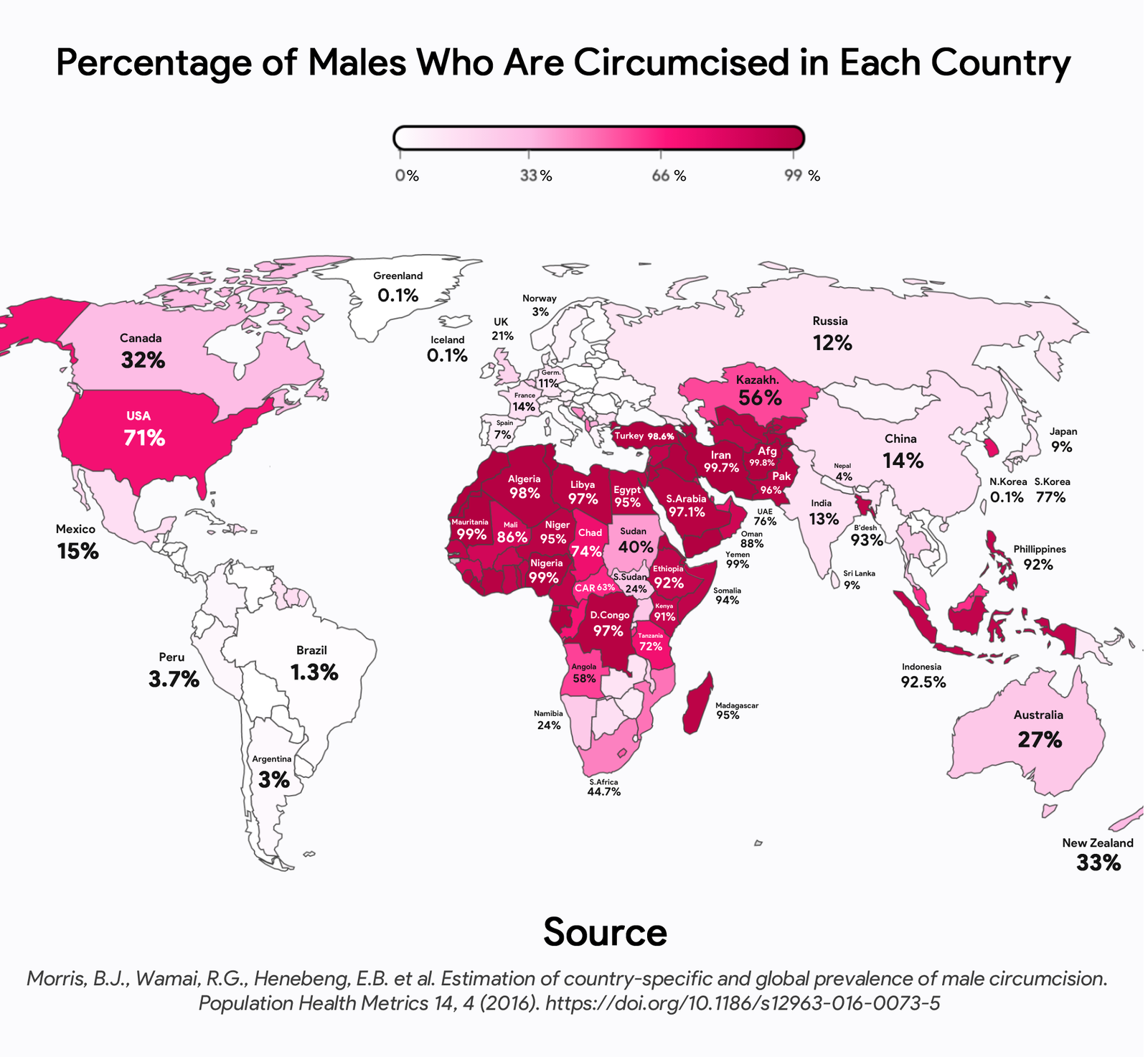
Researchers estimate that about 37 to 39 percent of males globally are circumcised. This figure comes from a large review covering 237 countries, combining survey data, census figures, and religious population estimates.
Source: Population Health Metrics
https://pophealthmetrics.biomedcentral.com/articles/10.1186/s12963-016-0073-5
Rates differ sharply by country and region.
Selected countries and estimated percentage of males circumcised
United States: about 80 percent
Israel: about 92 percent
Philippines: about 92 percent
South Korea: about 75 percent
Australia: about 26 percent
United Kingdom: about 21 percent
China: about 14 percent
India: about 13 percent
Japan: about 9 percent
Greece: about 5 percent
Argentina: about 3 percent
Source summary: Wikipedia, drawing from Population Health Metrics and national surveys
https://en.wikipedia.org/wiki/Prevalence_of_circumcision
Even within the same country, rates vary by age, religion, ethnicity, and migration background.
Beliefs and meanings across cultures
Circumcision carries different meanings depending on where you stand.
Religion
In Judaism, circumcision is a covenant ritual performed in infancy. In Islam, it is a widespread religious obligation, often performed in childhood. In these contexts, circumcision is about belonging, continuity, and faith rather than health or sexuality.
Medical tradition
In countries such as the United States and South Korea, circumcision spread during the 20th century through medical practice. Hygiene and disease prevention were central arguments, though recommendations have shifted over time.
Social norms
In some societies, circumcision signals adulthood, masculinity, or social acceptance. In others, remaining uncircumcised is the norm and carries no stigma.
Personal choice
Some adults choose circumcision later in life for comfort, hygiene, aesthetics, or sexual reasons. Others actively choose not to, based on bodily autonomy or sexual preference.
Sexual pleasure and sensation
Research on pleasure is often overstated in public debate. The data is more modest.
Large reviews of sexual function find no consistent difference in overall sexual satisfaction between circumcised and uncircumcised men. Some studies report changes in sensitivity. Others report no meaningful difference in arousal, orgasm, or satisfaction. Outcomes depend on individual anatomy, sexual practices, partner dynamics, and expectations.
For LGBTQ+ people, especially gay and bisexual men, pleasure is shaped far more by communication, consent, lubrication, arousal, and sexual role than by circumcision status alone. No high-quality evidence shows that circumcision reliably improves or harms sexual pleasure across populations.
Health effects and sexual health
This is where nuance matters.
HIV prevention
Randomized trials in parts of sub-Saharan Africa found that circumcision reduced female-to-male HIV transmission during vaginal sex by roughly 50 to 60 percent in those specific settings. Later reviews estimate smaller average effects across broader heterosexual populations.
Source example: PubMed
https://pubmed.ncbi.nlm.nih.gov/40661279
However, evidence for men who have sex with men does not show consistent protection. Most studies find little or no reduction in HIV risk for anal sex, whether insertive or receptive. Circumcision is not considered an effective HIV prevention tool for MSM.
For LGBTQ+ communities, the proven tools remain clear. Condoms. PrEP. Regular testing. Treatment as prevention.
Other health considerations
Circumcision can reduce the risk of conditions such as phimosis and recurrent inflammation of the glans. Some studies show lower rates of certain bacterial infections. Others show no difference. Good hygiene reduces many foreskin-related issues without surgery.
Risks and complications
Circumcision is surgery. Risks include bleeding, infection, pain, and cosmetic dissatisfaction. In clinical settings with trained providers, serious complications are uncommon. Risks rise when procedures are performed outside medical settings.
How this lands in LGBTQ+ communities
Views vary widely.
Some gay and bisexual men prefer circumcised partners. Some prefer uncircumcised. Many do not care. For trans women, trans men, and nonbinary people, circumcision may intersect with broader conversations about bodily autonomy and medical consent.
What unites most LGBTQ+ health advocacy is a focus on evidence. Circumcision is not a substitute for safer sex practices. It is not a marker of cleanliness or morality. It is one bodily variation among many.
Key sources
Global prevalence data:
https://pophealthmetrics.biomedcentral.com/articles/10.1186/s12963-016-0073-5
UNAIDS overview of male circumcision and public health:
https://www.unaids.org/sites/default/files/media_asset/jc1360_male_circumcision_en_0.pdf
Country-by-country prevalence summaries:
https://en.wikipedia.org/wiki/Prevalence_of_circumcision
Peer-reviewed HIV research:
https://pubmed.ncbi.nlm.nih.gov
Circumcision is neither a miracle nor a menace. It is a medical and cultural practice with specific effects, clear limits, and deeply personal meanings. Understanding those limits matters more than taking sides.