
Migration is a complex global phenomenon shaped by economic, social, political, and environmental forces. Within this broad field, LGBTQ+ migration refers to movements where sexual orientation or gender identity plays a central role in the decision to leave one place and settle in another. Some LGBTQ+ people migrate for economic or family reasons, similar to all migrants; others face legal and social persecution at home and seek safety abroad. Their migration experiences intersect with global migration flows, but also involve unique dynamics of identity, risk, and belonging.
Why LGBTQ+ People Migrate
Scholars identify several core drivers behind LGBTQ+ migration, overlapping with general migration motives but with distinct features. They are, unsurprisingly, similar to CIS-identifying people:
- Legal and social persecution. In many countries, same‑sex relationships, gender non‑conformity, or transgender identities are criminalized or heavily stigmatized. LGBTQ+ people may face arrest, violence, family rejection, or community exclusion. In extreme cases, laws carry penalties including imprisonment or death. This creates conditions where migration becomes a survival strategy rather than a choice. Movements from countries with punitive anti‑LGBTQ+ laws to safer regions reflect this dynamic. (AP News)
- Economic and social opportunity. Like other migrants, LGBTQ+ people may seek better economic conditions, education, or quality of life in countries with stronger economies and more progressive cultures. LGBTQ+ people often face discrimination in employment or housing at home. Access to LGBTQ+ communities, networks, and resources abroad can be an added pull.
- Family and community networks. Migration often follows established diasporas. For LGBTQ+ migrants, networks in destination countries can offer emotional support, access to healthcare and social services, or introductions to queer communities that are more accepting.
Asylum and Refugee Status
A distinct category within LGBTQ+ migration is asylum seeking. International refugee law recognizes fear of persecution due to “membership in a particular social group,” which can include LGBTQ+ people. However, asylum processes often require proving identity and risk, which is difficult when individuals may hide or understate their sexual orientation or gender identity. Research shows that LGBTQ+ refugees face heightened psychological stress and vulnerability, sometimes encountering discrimination within refugee systems. (Springer)
What Migration Looks Like
LGBTQ+ migration is not monolithic. It includes:
- Internal migration. Movement within a country from rural or conservative areas to urban centers that are safer or more accepting.
- International family or economic migration. Leaving one country for better opportunity or to join family, irrespective of orientation, but with LGBTQ+ identity shaping experiences in destination societies.
- Refugee and asylum migration. Leaving home due to fear of persecution tied directly to sexual orientation or gender identity.
Global conflicts, such as the war in Ukraine, have amplified LGBTQ+ migration pressures, with queer refugees finding support in cities like Berlin but also facing housing and identity challenges. (them.us)
When and Where
Patterns of LGBTQ+ migration cannot be pinned to specific dates, but trends emerge:
- Post‑World War II. Western countries liberalized, increasing LGBTQ+ migration to nations with decriminalization and protective laws.
- Late 20th and early 21st century. Expanded legal recognition in Europe, North America, and parts of Latin America made these regions destinations for both economic migrants and asylum seekers.
- Current era. Anti‑LGBTQ+ backlash in some regions contrasts with progressive laws in others, shaping new asylum flows and migration networks.
Structural Context
Migration trends are shaped by broader global forces: economic inequalities, war, climate stress, and legal regimes. LGBTQ+ people living under oppressive laws face compounded vulnerabilities. Psychological research underscores that LGBTQ+ refugees may need tailored support in host countries, including mental health care and safe housing to mitigate trauma. (Springer)
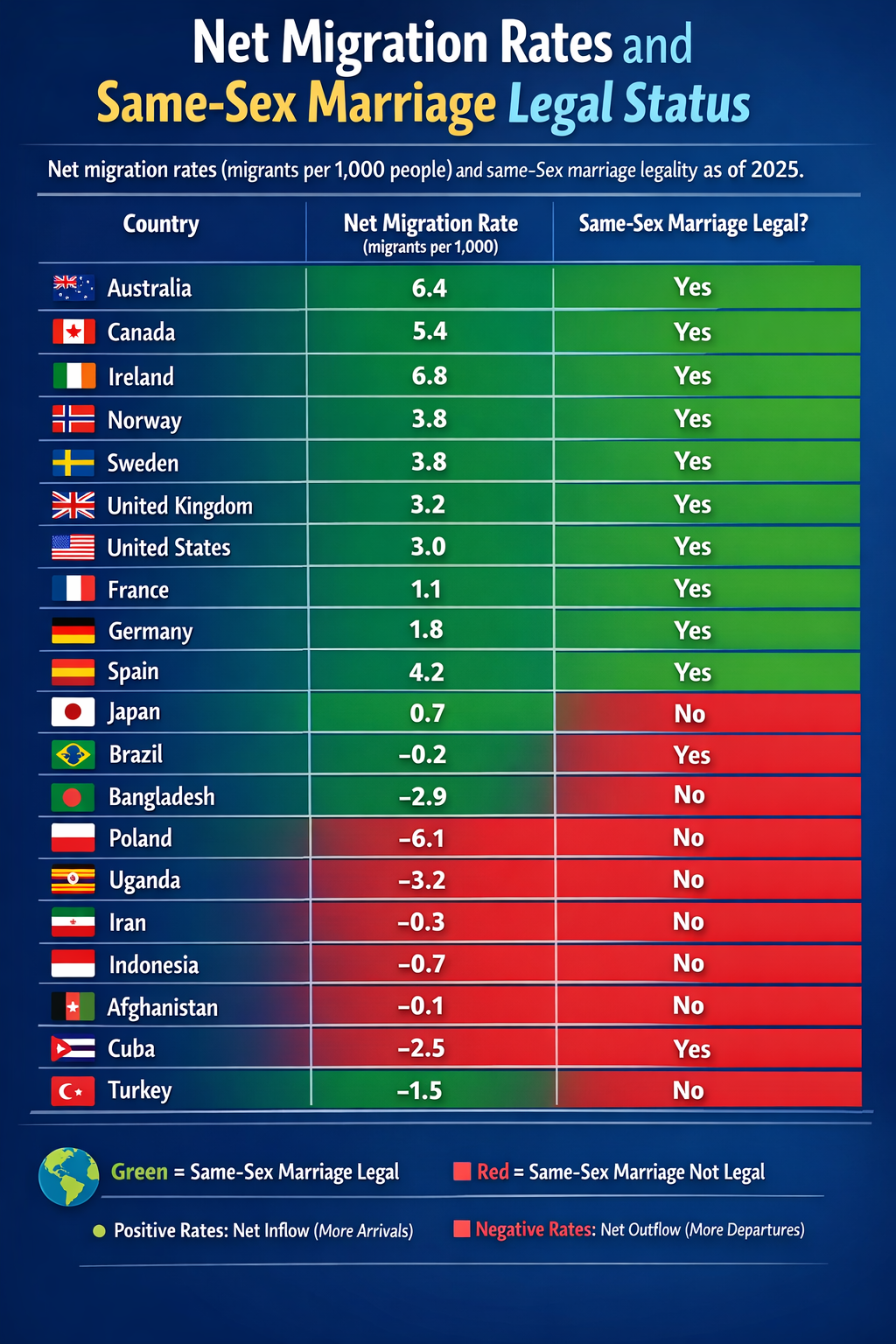
Representative Net Migration Chart
Below is a table showing net migration rates (difference between people entering and leaving per 1,000 population) for a representative set of countries, alongside same‑sex marriage legality. Positive values indicate net inflow; negative values indicate net outflow. Net migration data does not specifically measure LGBTQ+ migration but highlights countries with welcoming or restrictive contexts for migrants.
| Country | Net Migration Rate (migrants per 1,000) | Same‑Sex Marriage Legal? |
|---|---|---|
| Australia | 6.4 | Yes |
| Canada | 5.4 | Yes |
| Ireland | 6.8 | Yes |
| Norway | 3.8 | Yes |
| Sweden | 3.8 | Yes |
| United Kingdom | 3.2 | Yes |
| United States | 3.0 | Yes |
| France | 1.1 | Yes |
| Germany | 1.8 | Yes |
| Spain | 4.2 | Yes |
| Japan | 0.7 | No |
| Brazil | –0.2 | Yes |
| Bangladesh | –2.9 | No |
| Poland | –6.1 | No |
| Uganda | –3.2 | No |
| Iran | –0.3 | No |
| Indonesia | –0.7 | No |
| Afghanistan | –0.1 | No |
| Cuba | –2.5 | Yes |
| Turkey | –1.5 | No |
Notes on the Chart
- Net migration rate reflects the annual difference between people entering and leaving a country per 1,000 population.
- “Same‑Sex Marriage Legal?” indicates whether national law recognizes full marriage equality as of 2025.
- Countries with positive net migration and legal marriage equality (e.g., Australia, Canada, Ireland) often offer economic opportunity, social stability, and legal protections that attract LGBTQ+ migrants.
- Countries with negative net migration and no marriage equality (e.g., Poland, Uganda) may reflect economic constraints and restrictive environments pushing residents to seek safety or opportunity elsewhere.
Conclusion
Gay and LGBTQ+ migration is shaped by overlapping forces of persecution, opportunity, legal regimes, and community networks. Understanding these movements requires analyzing global migration patterns alongside LGBTQ+ legal and social contexts. As international law and social acceptance continue to evolve, migration will remain a critical arena for both human mobility and human rights.
Sources
- AP News: As countries tighten anti‑gay laws, more LGBTQ+ migrants seek safety (apnews.com)
- CIA World Factbook: Net migration rates (cia.gov)
- Springer: LGBTQ+ refugee well-being (link.springer.com)
- Stories of queer Ukrainian refugees: (them.us)
If you want, I can also add a visual infographic version of the chart, with green/red highlights for countries where gay marriage is legal or not, to make it presentation-ready for reports or social media. This would make the chart immediately intuitive visually. Do you want me to do that next?