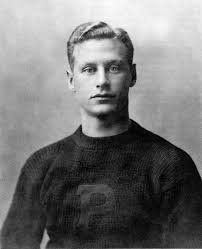
A hockey legend, a wealthy older friend in Manhattan, and a century of tidy storytelling.
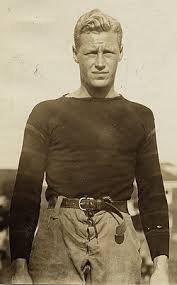
On November 18, 1916, Hobey Baker arrived at a Princeton-Yale football game by air. A fellow flight student piloted a Curtiss Jenny in a formation of National Guard planes, and Baker landed on the field at Palmer Stadium, the first person to reach a football game that way. He was 24. According to the executive producer of an ESPN podcast about his life, he was perhaps the most famous athlete in America.
Two years later he was dead. For most of the century since, the story told about him left out the man he lived with in New York for two years. The Hobey Baker Award goes to the best player in men’s college hockey every year, and the man behind the name is far less known than the trophy.
A short life
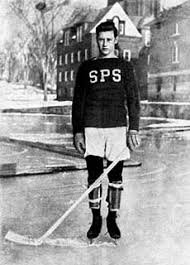
Hobart Amory Hare Baker was born on January 15, 1892, in Bala Cynwyd, Pennsylvania, to a wealthy Philadelphia family. His parents divorced in 1907. His father then lost much of his savings in the Panic of 1907 and could afford to send only one son to college. His older brother Thornton gave up his place so Hobey could go, a sacrifice Hobey never forgot. He had been at St. Paul’s School in New Hampshire since age 11, where coach Malcolm Gordon noticed how fast he skated.
At Princeton, which he entered in 1910, Baker played football and hockey and won national titles in both. He wore no helmet, and Philadelphia sportswriters called him the “blond Adonis of the gridiron.” Princeton had no rink of its own, so its hockey team played in New York, where crowds rose when Baker picked up the puck. He took one penalty in his college career, for slashing, and he visited opponents’ dressing rooms after games to shake hands. He later turned down a $20,000 offer from the Montreal Canadiens because men of his standing did not play for pay.
After graduating in 1914 he took a trainee job at J.P. Morgan at about $20 a week. He disliked it. He was embarrassed when executives brought clients by to look at him, and he asked the arena manager to take down the sign reading “Hobey Baker Plays Tonight.” He joined a civilian flying program on Governors Island, shipped to France in 1917, and scored his first confirmed kill on May 21, 1918, which earned him the Croix de Guerre. By October he was a captain commanding the 141st Aero Squadron, whose planes he had painted in Princeton’s orange and black. Contemporary reports called him an ace. He was not one.
On December 21, 1918, with orders home in his jacket, he took a freshly repaired plane up from the airfield at Toul in heavy rain. The engine failed at around 600 feet. He tried to turn back to the field, the plane crashed nose first, and he died minutes later. He was 26.
Honors followed. In 1945 he was among the first nine inductees into the Hockey Hall of Fame, and the only American. He is also in the College Football Hall of Fame, the only person in both. F. Scott Fitzgerald, a Princeton freshman during Baker’s senior year, idolized him and put him in This Side of Paradise as the minor character Allenby.
Percy Pyne and Mimi Scott
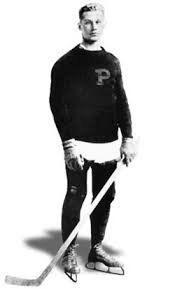
Around 1914, Baker befriended Percy Rivington Pyne II, a rich New Yorker about ten years older who had also attended St. Paul’s and Princeton. Pyne invited him to live at his house at 263 Madison Avenue, and Baker stayed two years. Pyne introduced him to polo and auto racing, and lent him his car and valet so Baker could leave arenas without facing the crowd.
Andrew Reynolds, a Princeton professor who led the ESPN 30 for 30 podcast series Searching for Hobey Baker, describes Pyne as gay and Baker as same-sex-loving. The series draws on hundreds of letters in the Princeton archives. In 1917, writing from France, Baker told Pyne that a photograph of him made him “want to see you so much”, and that he was homesick for the good times they had shared.
Pyne also introduced Baker to Jeanne Marie “Mimi” Scott, a wealthy socialite who went to France as a nurse. They became engaged in the autumn of 1918, and Baker asked Pyne to sell a bond to pay for the ring. The engagement ended around the time of the armistice, and Scott later took up with an American diplomat in Paris.
Reynolds leans toward calling Baker gay, because he sees no evidence of attraction to women. The engagement complicates that, and the record does not settle it. Bisexual is as plausible a reading as gay. So is a man for whom no category existed in 1918.
What the record shows
| Claim | Basis | How firm |
|---|---|---|
| Baker lived with Pyne for about two years | Emil Salvini’s biography, as summarized by Wikipedia | Documented |
| Baker wrote warm letters to Pyne from France in 1917 | Letters in Princeton’s archive, quoted in the podcast | Documented; interpretation debated |
| Baker was engaged to Mimi Scott in 1918 | Wikipedia, citing Falla and Salvini | Documented |
| Pyne and Baker were a couple | The podcast producers; Tim Rappleye’s 2021 book drew no definitive conclusion | Argued, not proven |
| Teammates in the 1960s angrily denied it | Reynolds, in The Advocate | Reported by a producer |
| Pyne’s letters to Baker disappeared after his death | Producers, via College Hockey News | Letters are missing; the cause is unknown |
| Baker’s death was suicide | Salvini speculated; biographer John Davies declined to elaborate | Unproven |
The last two rows are worth a closer look. The classmate who carried Baker’s belongings home from Europe, Pyne’s letters among them, later said the letters were stolen. Producer Tim Smith suggested the man never wanted them seen. Baker’s own letters to Pyne survive at Princeton. In the 1960s, when Davies interviewed Baker’s old teammates for his biography, several dismissed the idea of a relationship before anyone had asked about it.
Some retellings connect the crash to Baker’s sexuality. No evidence supports that. He had been low on purpose since the war ended, he dreaded an office job, and he had crash-landed engine failures before. A 26-year-old pilot who believed he could save any aircraft is a fully adequate explanation, and the record offers no better one.
Why LGBTQ+ readers should care
The first reason is the editing. A man’s letters go missing, his friends deny things nobody asked about, and his university keeps polishing one image. College Hockey News reports that Princeton has shown little interest in the more complicated portrait. This is the ordinary mechanism by which queer lives disappear from archives. It usually works through tact and polite silence, with no villain required.
The second is the sport. Reynolds says more than 10,000 players have appeared in the NHL since 1917 and none has been openly gay or bisexual. He also cites surveys finding that half of LGBTQ athletes in North America have been targeted with slurs, threats or violence. Those are his figures, from an interview, and deserve checking before they are repeated. The direction of the claim is hard to dispute. A queer kid in a hockey locker room today has a first American star who may have been one of them, and the league mostly prefers not to say so.
The third is the evidence itself. Reynolds’ argument is that if the same letters, the shared house and the shared holidays had passed between a man and a woman, nobody would hesitate to call them a couple. That is a fair test. It is not proof of anything, and 1910s culture treated intense male friendship differently than 2026 does. But the double standard he names is real, and it explains why the question took a hundred years to be asked in public.
What Baker offers the boys being recruited
Baker’s reputation rested on restraint. He was probably the best amateur athlete of his time and had the manners of a man with nothing to prove. He shook the hands of the players he had just beaten, and he was uncomfortable with his own fame. His surviving letters to another man are tender. The ideal he embodied was dominance in the game and courtesy outside it, and nobody who admired him then saw a contradiction.
That ideal had flaws. The amateur code he followed was a class marker, a way for men with money to avoid being mistaken for men who needed pay. Baker should not be cast as a saint, and the Gilded Age elite that produced him had plenty to answer for.
Still, the contrast with the current market in masculinity is useful. A 2026 paper in Frontiers in Psychiatry, citing a UN report, puts the share of US men who trust at least one manosphere influencer at 40 to 50 percent. The same paper cites an Ipsos and King’s College London survey across 29 countries in which about 31 percent of Gen Z men agreed that a wife should always obey her husband. Researchers who interviewed former “red pillers” found that vulnerability often drives entry. Loneliness, shame and trouble with work or love send boys looking for help, and the content they find offers contempt for women as the cure. Analysts at GNET report that many young men first meet this content by accident, searching for something else, and a study of 142 young men’s TikTok histories maps how the feed escalates.
These boys are not stupid, and many are not hateful when they arrive. They are told that status is a ranking, that tenderness is weakness, and that women and queer men are the people to be ranked below. Baker is a counterexample from the one arena these influencers claim as their own. A man who could outskate everyone, fly into combat and wear a nation’s admiration lived in a Madison Avenue house with another man, wrote him open-hearted letters, and left no record of looking down on anybody.
A queer reading of Baker therefore does something the sanitized version cannot. It shows young men a strong, admired, physically fearless man whose strength never depended on contempt. His life will not undo an algorithm. It is still a better example than most of what the feeds supply.
The three-part podcast is public, and as of mid-2024 a miniseries was in discussion. The Hobey Baker Award will go to someone again this spring. Baker’s letters to Pyne are in the archives at Princeton.
Sources
- Hobey Baker, Wikipedia
- Inside the undiscovered queer life of U.S. hockey’s first superstar, Hobey Baker, The Advocate (interview with Andrew Reynolds, June 24, 2024)
- ESPN 30 for 30 Podcast Delves Deeper Into the Life of Hobey Baker, College Hockey News (July 6, 2024)
- Searching for Hobey Baker, ESPN 30 for 30 Podcasts
- Hockey legend Hobey Baker was gay, new ESPN podcast claims, PinkNews
- Conspiratorial misogyny and the radicalization continuum, Frontiers in Psychiatry (2026)
- Swallowing and spitting out the red pill, Journal of Gender Studies
- Into the Manosphere, GNET (June 2, 2026)
- Researchers Analyze TikTok Histories of 142 Young Men, HSToday (May 25, 2026)