
The short answer on pirates is “maybe, and the evidence is thinner than the legend.” The longer answer covers a lot more ground, because the same pattern shows up everywhere same-sex desire left a record. It was real, and sometimes celebrated. It was almost never organized the way modern identity is. Societies sorted it by age, rank and role: who was on top, who was younger, who was free, who was owned.
That distinction does a lot of work below. Several of the best-documented cases pair adult men with adolescents, which modern consent standards would call abuse. The sources treat those relationships as normal or even noble. This piece reports what they say without endorsing it.
Pirates: matelotage and a contested thesis
In the seventeenth-century Caribbean, buccaneers on Hispaniola and Tortuga practiced matelotage. A matelot was a partner who shared property and, by custom, inherited it if the other died. Wikipedia’s overview of the practice traces it through the French chronicler Alexandre Exquemelin and notes that most interpretations see a mutual-insurance bond between men who spent years without women.
B.R. Burg made the sexual reading famous in Sodomy and the Pirate Tradition, arguing that same-sex relations were central to buccaneer life. Hans Turley pushed back in Rum, Sodomy, and the Lash, arguing that the documentary evidence is thin and that “the pirate” is partly a literary figure who carries later ideas about masculinity. The sturdier claim is the narrower one. Matelotage was a formal male partnership with legal weight, and sex was plausibly part of some of them. Nobody can say how many.
The best-known queer pirates are women. Anne Bonny and Mary Read, who sailed with Calico Jack Rackham in the 1720s, lived as men aboard ship, and the standard account has Bonny falling for Read before learning she was a woman. That makes a good story, and it rests on one contemporary pamphlet. Treat it as legend with a factual core.
Thebes: the army of lovers
Plutarch describes the Sacred Band of Thebes as 150 pairs of male lovers, formed around 378 BC by the commander Gorgidas, who reportedly drew on the idea in Plato’s Symposium of an army made of lovers and beloveds. The logic was that men would sooner die than shame themselves in front of the person they loved. Under Pelopidas, the Band helped beat Sparta at Tegyra in 375 BC and Leuctra in 371 BC. It was destroyed at Chaeronea in 338 BC by Philip II of Macedon and his son Alexander.
The ending has physical evidence, which most ancient love stories lack. In 1880, the archaeologist Panagiotis Stamatakis found 254 skeletons in a mass grave at Chaeronea, laid out in rows. His findings went unpublished and the grave was covered again. In his 2021 book on the Band, James Romm reconstructed the layout from Stamatakis’s surviving notes. Reviewers highlight the skeletons that appear to be paired, one with an arm over the other, others linked at the elbows. Plutarch counted 300 men, so 46 are unaccounted for. Philip, according to Plutarch, ordered that anyone who suspected these men of anything shameful should perish.
The Band was also unusual. Classical Greek convention generally paired an older lover with a younger beloved. The Theban unit was a military institution of adults.
Rome: rank, not orientation
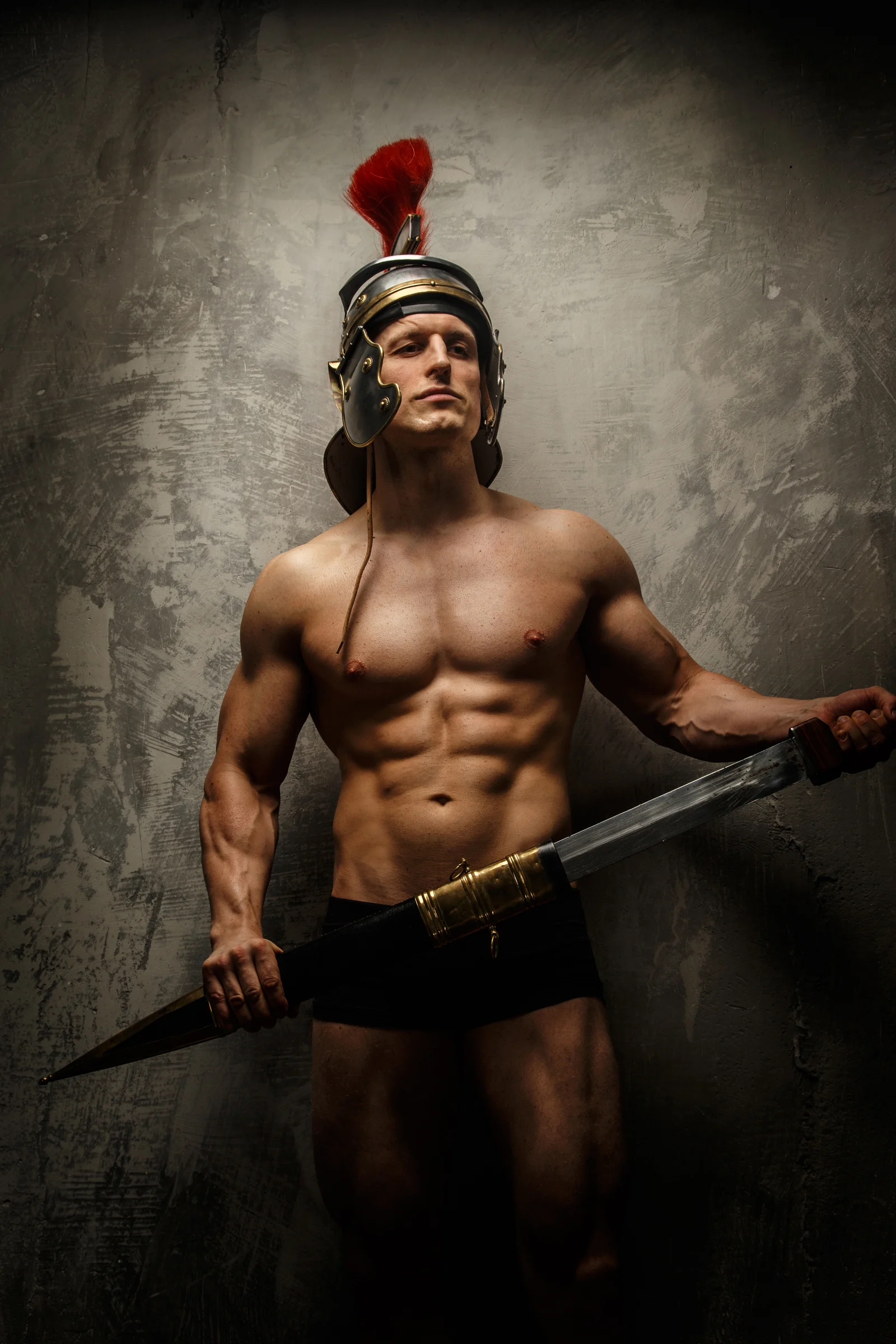
Roman men could have sex with other males without losing status as long as they took the dominant role. Craig Williams, whose Roman Homosexuality is the standard study, calls that active role the prime directive of Roman masculinity. The partner mattered. A free man could sleep with a slave, a former slave, a prostitute or an actor without penalty. Free Roman boys were off-limits, and so was another free man of equal rank, because being penetrated damaged a citizen’s standing. Politics reflects the stakes. Julius Caesar spent much of his career fending off rumors that he had been a passive partner to a king.
The empire supplies the famous couples. Nero married a young man and had him castrated, and Titus reportedly kept many male concubines. The best documented case is Hadrian and Antinous. Antinous was a Bithynian youth who traveled with the emperor from about 128 and drowned in the Nile in October 130, close to age 20. Scholars dispute the age at which the relationship began. Hadrian deified him and founded the city of Antinoopolis in his honor. The cult lasted into the fourth century, long enough for Christian writers to condemn it. Modern queer communities have also adopted Antinous as a figure.
Vikings: the record of shame
Norse sources tell a harder story, and an honest one. Nearly everything survives as insult. The words níð and ergi described a man who was passive, unmanly, cowardly or “inclined to play the female part.” Calling a man argr was grounds for outlawry in both the Icelandic Grágás and the Norwegian Gulathing law. The Fordham sourcebook reads the evidence as showing no shame in the active role but severe contempt for the passive one, and observes that in nearly every instance of the accusation no one believes the target is actually having sex with men. The charge was a weapon.
The myths show what the culture feared. Loki trades sexual insults with the gods in the Lokasenna. In the Þrymskviða, Thor resists wearing a bridal gown because the Æsir will call him ergi, and Icelandic law explicitly forbade cross-dressing. The sources contain almost nothing on love between women.
The one striking physical find is Finnish and on the edge of the Viking world. In 1968, workers at Suontaka, Hattula, uncovered a grave from about AD 1050 to 1300 holding a person in women’s clothing with a sword at the hip. Archaeologists had read it as a female warrior or a double burial. In 2021, Ulla Moilanen and colleagues reported DNA suggesting a single individual with Klinefelter syndrome (XXY), buried with rich furs and objects. The team proposed a respected, possibly non-binary member of the community. The genetic result is probabilistic, and the grave concerns gender, not same-sex desire, so it bears on this topic only indirectly.
Samurai: the way of youths

Japan’s warrior class had a word for it, nanshoku (“male color”), and a code, shudō or wakashudō. An older samurai took a younger partner, the wakashu, as a protégé and lover, and the relationship was supposed to last until the youth’s coming-of-age ceremony. Gary Leupp, in Male Colors, describes it as a “brotherhood contract” that was meant to be exclusive and mutually beneficial.
The famous cases involve warlords. Takeda Shingen’s relationship with Kōsaka Masanobu began around 1543 when they were 22 and 16. A surviving letter from Shingen reassures his younger partner that he has not been unfaithful with another retainer, and says that because he wants to be intimate with Masanobu he will do the boy no harm. It reads as a lover’s apology. Sources disagree on the exact year, so the early 1540s is the safe date. Oda Nobunaga’s attachment to Mori Ranmaru is also well known, though some accounts concede there is no hard evidence.
The literature is the richest anywhere on this list. Ihara Saikaku’s The Great Mirror of Male Love (1687) gathers 40 stories, 20 about samurai and 20 about kabuki actors, and was expected to be a best-seller. Paul Gordon Schalow’s English translation notes that Saikaku adopted a stance that disparages women to elevate male love, which many modern readers find offensive. The tradition faded after the Meiji Restoration of 1868, when Japan’s modernizers began to treat it as backward.
A short tour of other places
| Place and era | Who | What the record shows | Caveat |
|---|---|---|---|
| Egypt, c. 2400 BC | Khnumhotep and Niankhkhnum | A shared tomb at Saqqara, found in 1964, shows the two men embracing and nose to nose, the form a kiss took in Egyptian art | Both appear with wives and children. Some Egyptologists read them as brothers or twins; Greg Reeder and Richard Parkinson argue for a couple |
| China, 1 BC | Emperor Ai of Han and Dong Xian | The emperor cut off his own sleeve rather than wake Dong, who was asleep on it, giving Chinese the phrase “passion of the cut sleeve” | A court chronicle, written for political ends. Both men were married |
| Florence, 1432 to 1502 | The Office of the Night | About 17,000 men investigated and 3,000 convicted in a city of about 40,000. German slang used “Florenzer” for sodomite | Michael Rocke’s reading is that sodomy was part of ordinary masculinity, with roles set by age. The data come from prosecution records |
| London, 1724 to 1726 | Margaret Clap’s molly house | Her Holborn coffee house hosted 30 to 40 men a night, with beds in every room | The Society for the Reformation of Manners raided it in February 1726. Three men were hanged at Tyburn that May |
| Yorkshire, 1834 | Anne Lister and Ann Walker | The two women took communion together at Holy Trinity, York, and considered it their marriage | No legal standing. Lister’s explicit diaries were written in a code that John Lister cracked in the 1890s |
What the pattern shows
The cases share three features. First, evidence for institutions is better than evidence for feelings. The Sacred Band, matelotage, the Office of the Night and Mother Clap’s house were all organizations with records, and those records exist because someone organized, taxed, or prosecuted them. Second, hostility preserved much of what survives. The Vikings are known through insults, Florence through court files, the molly houses through informers and trials. Third, age and rank structured nearly everything. That means “ancient gay history” is mostly the history of male status systems, in which same-sex desire was ordinary until it threatened someone’s position.
The best argument for studying these cases is what they refuse to confirm. Ancient societies did not have a gay minority with a name. They had rules about who could do what with whom. Rome’s rules differed from Thebes’s, and Japan’s from Florence’s. The modern idea that attraction defines a person is the exception. Reading the past as proof that “we were always here” flattens most of what the sources say.
Lister is the closing exception, and a rare one. She did not leave a court file or a satirist’s jab. She wrote her own account, privately, in her own cipher, and the diaries are now part of UNESCO’s Memory of the World register.
Sources
- Wikipedia, Matelotage
- Goodreads, Burg, Sodomy and the Pirate Tradition
- Turley, Rum, Sodomy, and the Lash (excerpt)
- glbtq archive, Pirates
- History Skills, Sacred Band of Thebes
- HeritageDaily, Sacred Band
- The American Scholar, “Warrior Eros” (on Romm)
- Wikiwand, Homosexuality in ancient Rome
- University of Birmingham, Male homosexuality in ancient Rome
- Wikipedia, Antinous and World History Encyclopedia, Antinous
- Fordham Sourcebook, Homosexuality in the Viking Age
- Goodreads author blog, Viking attitudes
- Meliora, Þrymskviða and Grágás
- The Past, Suontaka grave
- Wikipedia, Kōsaka Masanobu
- Tokyo Weekender, Nanshoku and Iromegane, Nanshoku
- Wikipedia, The Great Mirror of Male Love and Schalow translation excerpt
- Wikipedia, Khnumhotep and Niankhkhnum and Urania Institute
- Wikipedia, Dong Xian
- Rocke, Forbidden Friendships (publisher summary)
- Wikipedia, Margaret Clap and LGBT History UK, Mother Clap’s
- The National Archives, Anne Lister, LAPL, Lister diaries and Euromanticism