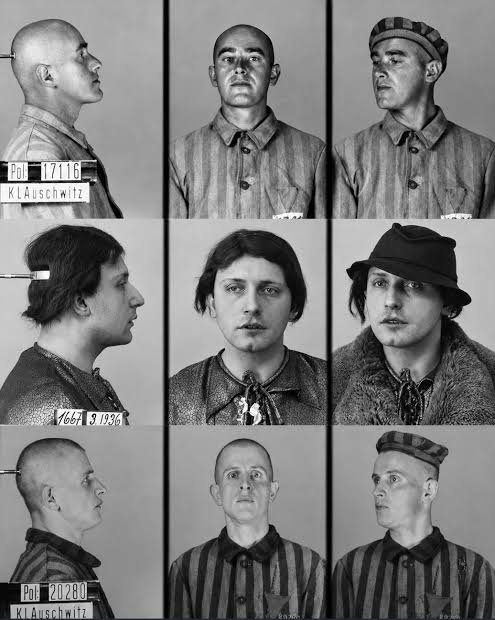
1. Top Row: Willi Pohl
- Identity: Willi Pohl
- Prisoner Number: 17116 (visible on the plaque in the left frame)
- Background: He was a textile worker from Lower Lusatia. He was deported by the Nazi regime under Paragraph 175 (which criminalized homosexuality) and arrived at the Auschwitz concentration camp on June 6, 1941, where camp photographer Wilhelm Brasse took his identification photos.
- Wartime Fate: Did not survive. He passed away due to the brutal and destructive conditions during his imprisonment at Auschwitz.
2. Middle Row: Fritz Kitzing
- Identity: Fritz Kitzing
- Background: Kitzing was a gender-nonconforming individual and antiques dealer from Berlin who dressed unapologetically in women’s attire. They were arrested multiple times by the Berlin police; the mugshots shown here were taken during an arrest in March 1936.
- Wartime Fate: Survived. Despite multiple arrests and being confined in Nazi concentration camps, Kitzing managed to survive the war. They lived a long life in West Berlin afterward, passing away in 1987.
3. Bottom Row: Walter John
- Identity: Walter John
- Prisoner Number: 20280 (visible on the plaque in the left frame)
- Background: He was a laborer from Upper Silesia. Like Willi Pohl, he was arrested under Paragraph 175 and sent to the Auschwitz concentration camp, where his registration mugshot was logged into the camp’s administrative records.
- Wartime Fate: Did not survive. Records indicate he passed away just two months after his deportation to Auschwitz.
In 1942, a 19-year-old Norwegian called Johan was working as an interpreter for the Germans in Trondheim. He was sent to a small coastal village, where a young German officer in a tight uniform was waiting for him. He later said the officer was among the most beautiful men he had ever seen. In 1999 the social anthropologist Hans Wiggo Kristiansen interviewed Johan, whose name is a pseudonym, along with 22 other older queer Norwegians, and NRK (Norway’s main TV and radio stations) retold the story under the headline “The male German tarts” (Dei mannlege tyskartøsene).
Until 2025, historians knew of only 15 Norwegians prosecuted for homosexuality during the occupation. Then Camilla Maartmann of the Grini Museum became the first researcher to go systematically through Norway’s prisoner registers. She found at least 156 men arrested for sex with other men: 63 Norwegians, one Dane, two Frenchmen and 90 German citizens. Sources differ slightly on the total, and the Norwegian encyclopedia gives at least 160.
Who the 90 Germans were
The NRK piece is often summarized as a story about gay Nazis. It is not. The 90 Germans were soldiers and civilians tried by Wehrmacht and SS courts, and the sources do not describe them as party officials. They also received harsher sentences than the Norwegians, whose terms ran from three months to three years. Of the 63 Norwegians, 14 were deported to German prisons or camps and the rest stayed in Norwegian jails.
The Germans were less interested in Norwegian men who slept with each other than in Norwegians who slept with German soldiers. Maartmann explains that the occupiers feared such men could turn soldiers into spies, and that the “contagion” would spread through the ranks. One man, “Erik”, had sex with a single German soldier and received a year in prison. The court admitted the sentence was severe and defended it as an education in “the dangerous path he had taken”.
Nobody has produced a reliable count of gay Nazi officials arrested. The regime destroyed the archive of its own anti-homosexuality office, and what survives is mostly police and court files. The best evidence on Nazi-affiliated men comes in fragments, which appear further down.
The numbers behind it
| Measure | Estimate | Source |
|---|---|---|
| Men arrested as homosexual, 1933–45 | about 100,000 | USHMM |
| Sentenced by civilian courts | about 50,000 | Wikipedia, citing Schwartz and others |
| Convicted by military courts | 6,400 to 7,000 | same |
| Held in concentration camps | 5,000 to 15,000 (some scholars say 5,000 to 6,000) | USHMM |
| Death rate in camps | 60 percent of 2,542 known cases, implying at least 3,100 to 3,600 dead | Lautmann, via Wikipedia |
| Castrated under pressure | an estimated 400 to 800 | Wachsmann, via Wikipedia |
Convictions under Paragraph 175 (German Criminal Code (§175 StGB) that criminalized sexual acts between men.) rose roughly tenfold, to over 8,000 a year by 1937, after the Nazis rewrote the law in 1935 to cover nearly any act between men. These are estimates built from scattered records. The regime also never planned to kill all gay men the way it planned to kill all Jews. The surviving paperwork describes a campaign of arrest, imprisonment, castration and, in the camps, death.
Lesbians were not systematically hunted. They had no equivalent criminal statute, and few are believed to have been arrested.
Röhm, the SA and the purge
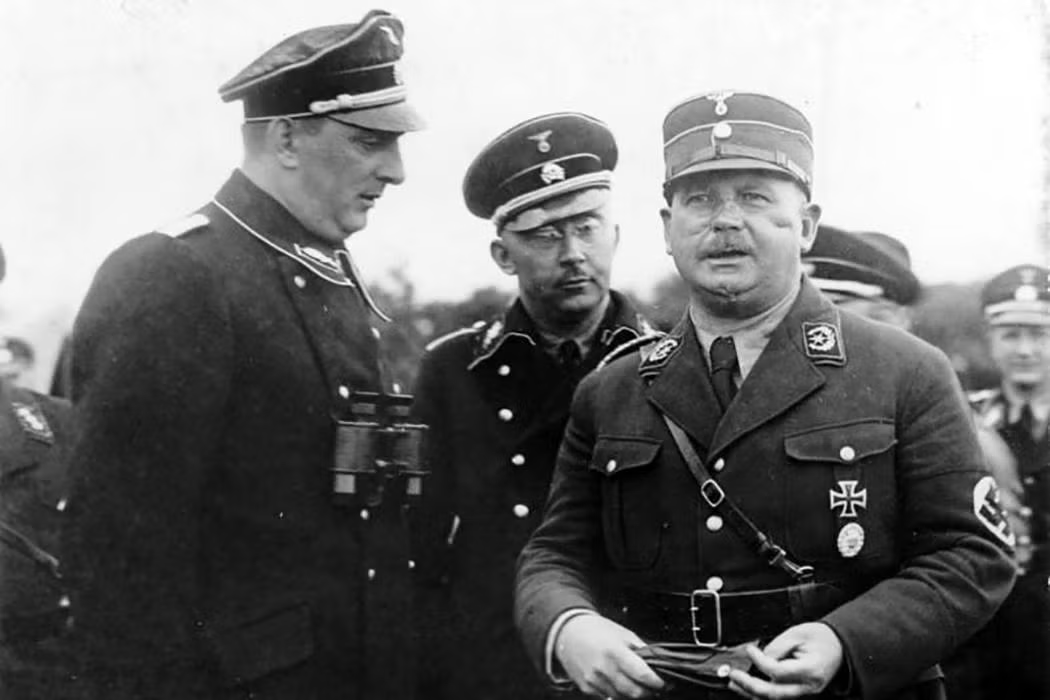
Nazis Kurt Daluege, Heinrich Himmler, Ernst Röhm in 1933 Wikimedia Commons/Bundesarchiv
Homosexuality stayed a public liability for the party well before 1933. In 1928 the Nazis answered a questionnaire on Paragraph 175 with the line that anyone who even thinks of homosexual love is an enemy. Then in 1931 and 1932 the Social Democrats publicized the homosexuality of Ernst Röhm, the SA chief, to embarrass Hitler. The scandal helped create a lasting myth that the party was full of gay men. Historians find no evidence that homosexuals were overrepresented in it.
On June 30, 1934, Hitler arrested Röhm at Bad Wiessee. The Night of the Long Knives ran until July 2 and killed at least 85 people. Hitler’s own list named 77, and some estimates run as high as 1,000. Propaganda cited Röhm’s sexuality and the claim that his deputy Edmund Heines was found in bed with another man. The physician and Röhm associate Karl-Günther Heimsoth was among the dead.
The purge was a power grab first. Hitler wanted the army’s loyalty and the SS wanted the SA’s place. Homosexuality worked as an explanation for the public, not as the cause. The practical effect came afterward. In October 1934, Heydrich ordered big-city police to list homosexuals, and a Gestapo unit began compiling the lists. In 1935 Paragraph 175 was widened. In 1936 Himmler set up the Reich Central Office for the Combating of Homosexuality and Abortion. Goebbels is reported to have said that when Himmler wanted someone gone, he simply used Paragraph 175.
Inside the ranks
Himmler told his SS generals in 1937 that the whole SS saw eight to ten homosexual cases a year. Geoffrey Giles’s study of the records shows he was understating badly. SS courts heard 16 cases in 1940, and recorded no fewer than 22 convictions in the first quarter of 1943 alone. Four SS men were arrested in Leipzig in 1937 and 1938. Another study found that 57 percent of men arrested for homosexuality in Düsseldorf belonged to a Nazi organization.
On November 15, 1941, Hitler signed a decree Himmler had drafted that made homosexual conduct by SS and police members punishable by death. Hitler insisted it stay unpublicized, apparently worried that publicity would feed the claim that homosexuality was widespread in Germany. Few death sentences followed. Himmler often commuted them, and many of the men were sent to the Dirlewanger Brigade, where most died.
Annexed and occupied lands
The regime applied its anti-homosexuality law to annexed areas but largely not to the rest of occupied Europe, because it cared little about punishing people it did not count as German. Prosecutions in Austria nearly doubled after the Anschluss. The Sudetenland got German law in 1938. Alsace-Lorraine got it in January 1942, applied retroactively.
Pierre Seel was 17 when he was arrested in Mulhouse in May 1941, probably through the old police files. He was sent to the Schirmeck camp and wore a blue bar, not a pink triangle. In the Czech Protectorate, non-Germans fell under the milder Austrian code. Rudolf Brazda, born in 1913 to Czech parents in Saxony, was re-arrested in 1941 and sent to Buchenwald in August 1942. He lived until 2011 and was the last known survivor deported specifically for homosexuality.
After 1945: the laws stayed
Allied authorities treated Paragraph 175 as ordinary law. Some men freed from the camps were recalled to prison to finish their sentences. Nobody has published a reliable count of how many. Camp survivors were refused reparations because the state still called them criminals.
| Year | Event |
|---|---|
| 1950 | East Germany drops the Nazi amendments. West Germany keeps them. |
| 1957 | West Germany’s Constitutional Court upholds the 1935 law. East German prosecutions largely stop. |
| 1968 | East Germany decriminalizes homosexuality. |
| 1969 | West Germany partly decriminalizes it. |
| 1985 | President Richard von Weizsäcker gives the first official recognition of the Nazi persecution. |
| 1994 | Paragraph 175 is repealed. |
| 2000 | The Bundestag passes a resolution regretting that the law outlived the Nazis. |
| 2002 | Nazi-era convictions are annulled. |
| 2017 | Post-war convictions are annulled and compensation is offered. |
Between 1945 and 1969, West Germany convicted about 50,000 men, the same number the Nazis convicted in twelve years. In 1962 the historian Hans-Joachim Schoeps remarked that for homosexuals the Third Reich was not yet over. Across both states, some 68,300 people were convicted under various forms of the paragraph, about 4,300 of them in East Germany.
The Bundestag voted to strike the law in March 1994, and it left the books that June. The apology came in pieces. In 2000 the Bundestag expressed regret, which the Irish Times reported as an apology. The Nazi-era annulment followed two years later. The full rehabilitation took until June 22, 2017, when the Bundestag voted unanimously and the Bundesrat approved on July 7. It paid €3,000 per conviction plus €1,500 for each year of prison begun, and about 5,000 of the convicted men were still alive. By September 2021, 249 people had been paid, about €860,000 in total.
Sources
- Ole Kristian Årdal, “Dei mannlege tyskartøsene”, NRK
- 63 norske menn ble arrestert for sex med tyske menn, forskning.no via ABC Nyheter
- Camilla Maartmann, Tysk straffeforfølgelse av homoseksualitet i Norge under 2. verdenskrig, Historisk tidsskrift, 2025
- Persecution of homosexuals in Nazi Germany and Paragraph 175, Wikipedia
- USHMM, Gay Men under the Nazi Regime
- Geoffrey Giles, The Denial of Homosexuality, Journal of the History of Sexuality, 2002
- Victims of the Night of the Long Knives, Wikipedia; Great Blood Purge, EBSCO
- Gay Nazis myth, Wikipedia
- Pierre Seel and Rudolf Brazda, Wikipedia
- NBC News, CNN and CBS News coverage of the 2017 law and compensation, linked above
- Irish Times, “Germany to rehabilitate gay men convicted in post-war era”