On May 29, 2026, Ghana’s parliament passed the Human Sexual Rights and Family Values Bill, 2025, despite strong opposition from the Minority Caucus, who threatened to withdraw the bill prior to passage. The bill now sits on the desk of President John Mahama, who will decide whether to sign it into law.
This has been a long time coming, and not in a good way.
An earlier version was approved by parliament in February 2024 with bipartisan support, but lapsed with the dissolution of Ghana’s parliament ahead of the 2024 general election. In March 2025, a group of 10 MPs reintroduced it as a private member’s bill. President Mahama said that while he supported the principle, he would prefer it introduced as a government bill rather than a private member’s bill. Parliament pressed on anyway.
The law imposes up to three years’ imprisonment for people who engage in homosexual relations, and between three and five years for the promotion, sponsorship or intentional support of LGBTQ+ activities. Some exemptions were included: lawyers can represent LGBTQ+ clients without penalty, the media can address these issues, and healthcare professionals can provide care or psychological support to LGBT+ people without fear of reprisal. Critics have pointed out that these carve-outs don’t change the fundamental brutality of the bill — they just make it look tidier for international consumption.
The bill was presented to parliament by the MP for Assin South, Rev. John Ntim Fordjour, on behalf of other sponsors. Advocacy group IDNOWA described the vote as “a critical test of collective resilience,” noting that while some professionals were protected, the bill still poses a serious threat to the safety and freedom of LGBTQ+ Ghanaians.
One thing analysts have been unusually direct about: the Trump administration’s anti-LGBTQ+ executive orders in the United States reduced fears among West African lawmakers that economic sanctions would follow anti-LGBTQ+ legislation, removing a practical check that had existed in earlier years. Put plainly, when the world’s most powerful democracy signals it doesn’t care, other governments notice.
Mahama’s position hasn’t exactly been a profile in courage. He said in February 2025: “I believe in the principles and values that only two genders exist — man and woman. And that marriage is between a man and a woman.”
Safety for LGBTQ+ people — including in “friendly” places
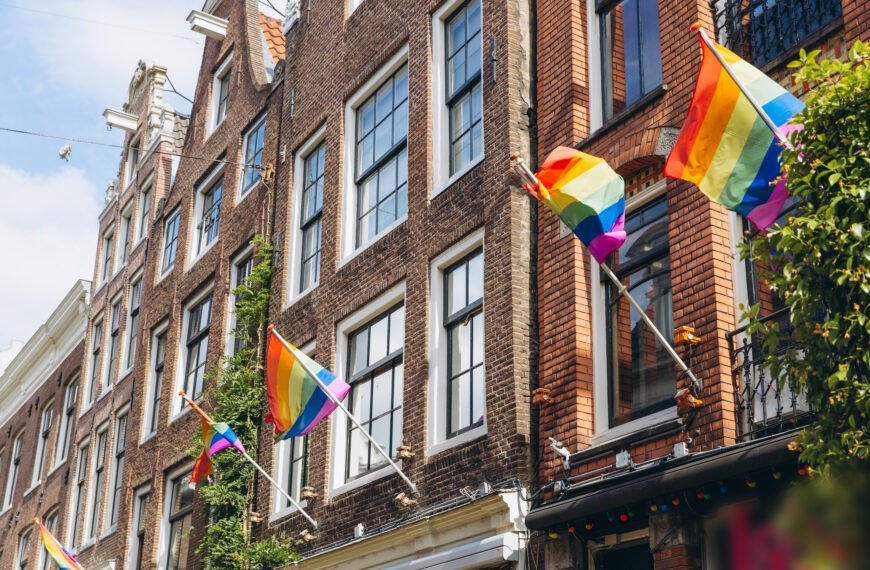
Let’s be honest about something that doesn’t get said enough: a rainbow flag on a bar window doesn’t make you safe. A city marketing itself to queer tourists doesn’t mean the street outside is welcoming. Choosing certain streets, showing certain displays of affection, or choosing the wrong vacation destination can pose a serious risk to one’s own safety even in countries considered gay friendly.
Hate crimes happen in Amsterdam, London, New York, and Berlin. They happen in June, during Pride month, sometimes at Pride events. London’s city assembly addressed homophobic attacks in the capital as recently as 2023, after incidents including an attack at the Two Brewers in Clapham. The city is by any measure progressive. That didn’t stop it.
Here’s what actually helps, wherever you are:
Trust your instincts over the label. “Gay neighborhood” is a marketing term as much as a safety guarantee. Pay attention to who’s around and how they’re behaving, not the branding.
Tell someone where you’re going. If you’re leaving a bar or club with someone you’ve just met, introduce them to a friend or the bartender before you go, so someone knows who you left with.
Travel with a local contact. Online communities — local LGBTQ+ organisations, expat groups, travel forums — can tell you which parts of a city are genuinely safe and which are complicated, in a way that a travel blog updated once in 2019 cannot.
Report incidents. Under-reporting is one reason hate crime statistics are unreliable and why resources don’t follow. Report to police, and also to organisations that track them: ILGA World, GALOP (UK), Lambda Legal (US).
Research before you travel. ILGA World’s annual report maps legal status by country. Equaldex has an interactive map. The Gay Travel Index ranks 200 countries annually. These aren’t perfect, but they’re far better than assuming.
Know that legal protection and social reality are different things. Same-sex marriage has been legal in France since 2013. France also logs thousands of anti-LGBTQ+ hate crimes per year. Legal equality is a floor, not a ceiling.
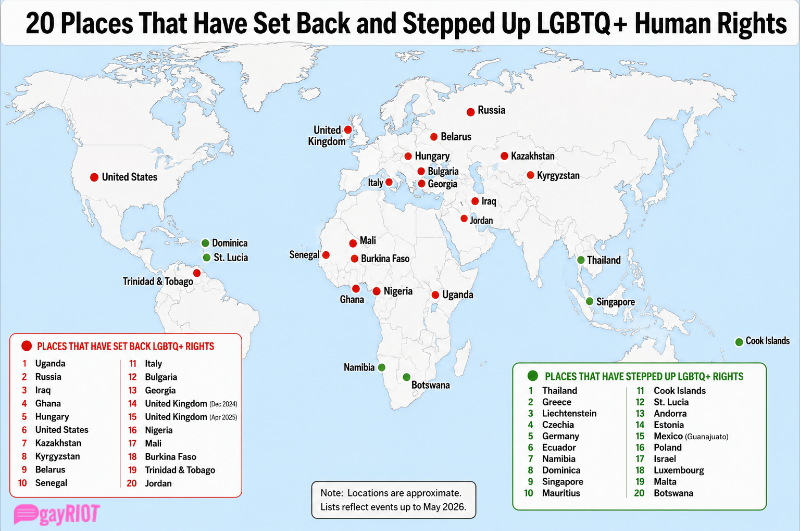
20 places that have set back LGBTQ+ rights recently
| # | Country/Place | When | What happened | Who drove it |
| 1 | Uganda | May 2023 | Signed Anti-Homosexuality Act imposing life imprisonment for same-sex acts and the death penalty for “aggravated homosexuality” | President Yoweri Museveni |
| 2 | Russia | Nov 2023 | Supreme Court declared the “international LGBT movement” an extremist organisation, effectively criminalising advocacy | Russian Supreme Court; backed by Putin administration |
| 3 | Iraq | June 2024 | Law criminalising homosexuality and transsexuality passed, with up to 15 years in prison; banned gender marker changes and gender-affirming care | President Abdul Latif Rashid |
| 4 | Ghana | May 2026 | Passed Human Sexual Rights and Family Values Bill criminalising same-sex acts (up to 3 years) and LGBTQ+ advocacy (up to 5 years) | MP Rev. John Ntim Fordjour (sponsor); President Mahama (pending signature) |
| 5 | Hungary | March 2025 | Parliament banned gatherings that “promote or display any deviation from a person’s sex at birth,” effectively outlawing Pride marches | PM Viktor Orbán / ruling Fidesz party |
| 6 | United States | 2025 | Executive orders barring transgender people from military service, targeting gender-affirming care, and removing federal LGBTQ+ protections | President Donald Trump |
| 7 | Kazakhstan | Feb 2024 | President signed ban on adoption for anyone not adhering to “non-traditional” sexual orientation, barring queer couples from adopting | President Kassym-Jomart Tokayev |
| 8 | Kyrgyzstan | 2023 | New law cracking down on LGBTQ+ organisations, banning information that “promotes non-traditional sexual relations” | Kyrgyz parliament |
| 9 | Belarus | 2023–24 | Began classifying content related to sexual and gender diversity as “pornography” | Government of Alexander Lukashenko |
| 10 | Senegal | 2024 | Signed law doubling the penalty for same-sex relations to 10 years in prison | President Bassirou Diomaye Faye |
| 11 | Italy | Oct 2024 | Senate approved law criminalising surrogacy abroad with fines up to €1 million, disproportionately impacting same-sex couples | PM Giorgia Meloni / Senate majority |
| 12 | Bulgaria | 2024 | Passed anti-LGBTQ+ legislation restricting rights and expression | Bulgarian parliament / President Rumen Radev |
| 13 | Georgia | 2024 | Passed law banning gender transition procedures and same-sex relationship recognition | Georgian Dream party |
| 14 | United Kingdom | Dec 2024 | Puberty blockers indefinitely banned following the Cass Review | Conservative government; upheld under Labour |
| 15 | United Kingdom | April 2025 | Supreme Court ruled the legal definition of “woman” is based on biological sex, removing legal recognition from trans women who have transitioned | UK Supreme Court |
| 16 | Nigeria | Ongoing | Same-Sex Marriage Prohibition Act 2014 continues in full force, with up to 14 years in prison; enforcement intensified in several states | Federal government |
| 17 | Mali | 2024 | Passed new restrictions criminalising LGBTQ+ visibility and expression | Military government junta |
| 18 | Burkina Faso | 2025 | Codified criminalisation of sodomy under new penal code | Military government |
| 19 | Trinidad & Tobago | 2025 | Enacted new sodomy criminalisation following conservative parliamentary push | Parliament of Trinidad & Tobago |
| 20 | Jordan | 2023 | Approved cybercrime law with vague provisions targeting LGBTQ+ expression online | Government of Jordan |
20 places that have advanced LGBTQ+ rights recently
| # | Country/Place | When | What happened | Who drove it |
| 1 | Thailand | 2024 | Passed marriage equality bill, making Thailand the first Southeast Asian country to legalise same-sex marriage | PM Srettha Thavisin; Coalition government |
| 2 | Greece | 2024 | Legalised same-sex marriage and adoption rights | PM Kyriakos Mitsotakis / New Democracy party |
| 3 | Liechtenstein | Jan 2025 | Marriage equality law entered into force | Prince Hans-Adam II (removed veto); parliament |
| 4 | Czechia | Jan 2025 | Legalised same-sex civil unions with full legal status | Czech parliament; passed April 2024 |
| 5 | Germany | 2024 | Self-identification law passed, allowing people to change legal gender through a simple administrative declaration | Chancellor Olaf Scholz / coalition government |
| 6 | Ecuador | 2024 | Introduced self-identification laws for legal gender change | Constitutional Court decision; government implementation |
| 7 | Namibia | 2024 | Supreme Court decriminalised same-sex sexual acts, striking down colonial-era sodomy law | Namibian Supreme Court |
| 8 | Dominica | 2023–24 | Decriminalised same-sex sexual activity following Eastern Caribbean court rulings | Eastern Caribbean Supreme Court |
| 9 | Singapore | 2023 | Officially decriminalised same-sex intimacy by repealing Section 377A | PM Lee Hsien Loong (announced 2022; enacted 2023) |
| 10 | Mauritius | Oct 2023 | Supreme Court struck down colonial-era sodomy law dating to 1838 as unconstitutional | Mauritian Supreme Court |
| 11 | Cook Islands | April 2023 | Parliament voted to decriminalise same-sex sexual activity between men | Cook Islands Parliament |
| 12 | St. Lucia | 2024 | Eastern Caribbean Supreme Court struck down sodomy laws | Eastern Caribbean Supreme Court |
| 13 | Andorra | 2023 | Legalised same-sex marriage | Andorran parliament / Co-Princes |
| 14 | Estonia | Jan 2024 | Became first former Soviet republic to legalise same-sex marriage | PM Kaja Kallas-era coalition; law enacted by parliament |
| 15 | Mexico (Guanajuato) | 2025 | Codified same-sex adoption rights in the state, the last Mexican state to do so | State legislature |
| 16 | Poland | 2024 | Ended remaining “LGBT-free zones” and reversed some anti-LGBTQ+ policies | PM Donald Tusk / Civic Coalition government |
| 17 | Israel | 2025 | Extended equality in adoption rights for same-sex couples | Israeli courts |
| 18 | Luxembourg | 2025 | Ended discrimination against same-sex couples in adoption | Luxembourg parliament |
| 19 | Malta | Ongoing, #1 in 2024 | Ranked first in ILGA-Europe Rainbow Index for the ninth year in a row | Government of Malta; PM Robert Abela |
| 20 | Botswana | 2019 / confirmed 2021 | High Court and Court of Appeal ruled that laws criminalising same-sex relations were unconstitutional | Botswana High Court and Court of Appeal |
The honest picture
One-third of the world continues to criminalise consensual same-sex sexual acts — 60 UN member states by law, and two more in practice. The global situation is polarising rather than converging. Countries that were already liberal are getting more so. Countries that were already hostile are getting worse. The middle is shrinking.
The West African region is a particular concern, with several countries moving in similar directions and advocates noting that the change in US foreign policy has removed a practical check on governments considering anti-LGBTQ+ legislation.
That said, the court rulings in Namibia, Mauritius, Dominica, and Singapore — countries that took the legal leap without the political cover of a strong international movement behind them — show something important. These changes can happen anywhere. They tend to happen when local lawyers, local activists, and local judges decide that colonial-era laws embarrass the nation more than they protect it.
Resources and further reading
Global legal tracking:
- ILGA World — State-Sponsored Homophobia report — the most comprehensive annual legal overview
- Equaldex interactive map — country-by-country legal status in real time
- Human Rights Watch LGBTQ+ page
- Amnesty International — LGBTQ+ rights
Travel safety:
- Spartacus Gay Travel Index 2025
- International Lesbian, Gay, Bisexual, Trans and Intersex Association
- AFAR — LGBTQ+ Travel Resources
Ghana bill specifically:
- NL Times — Ghana siren context
- France 24 — Ghana parliament approves anti-LGBTQ law
- Graphic Online — Bill details
- Ghana Citizenship — What the bill actually says
Reporting hate crimes / support: