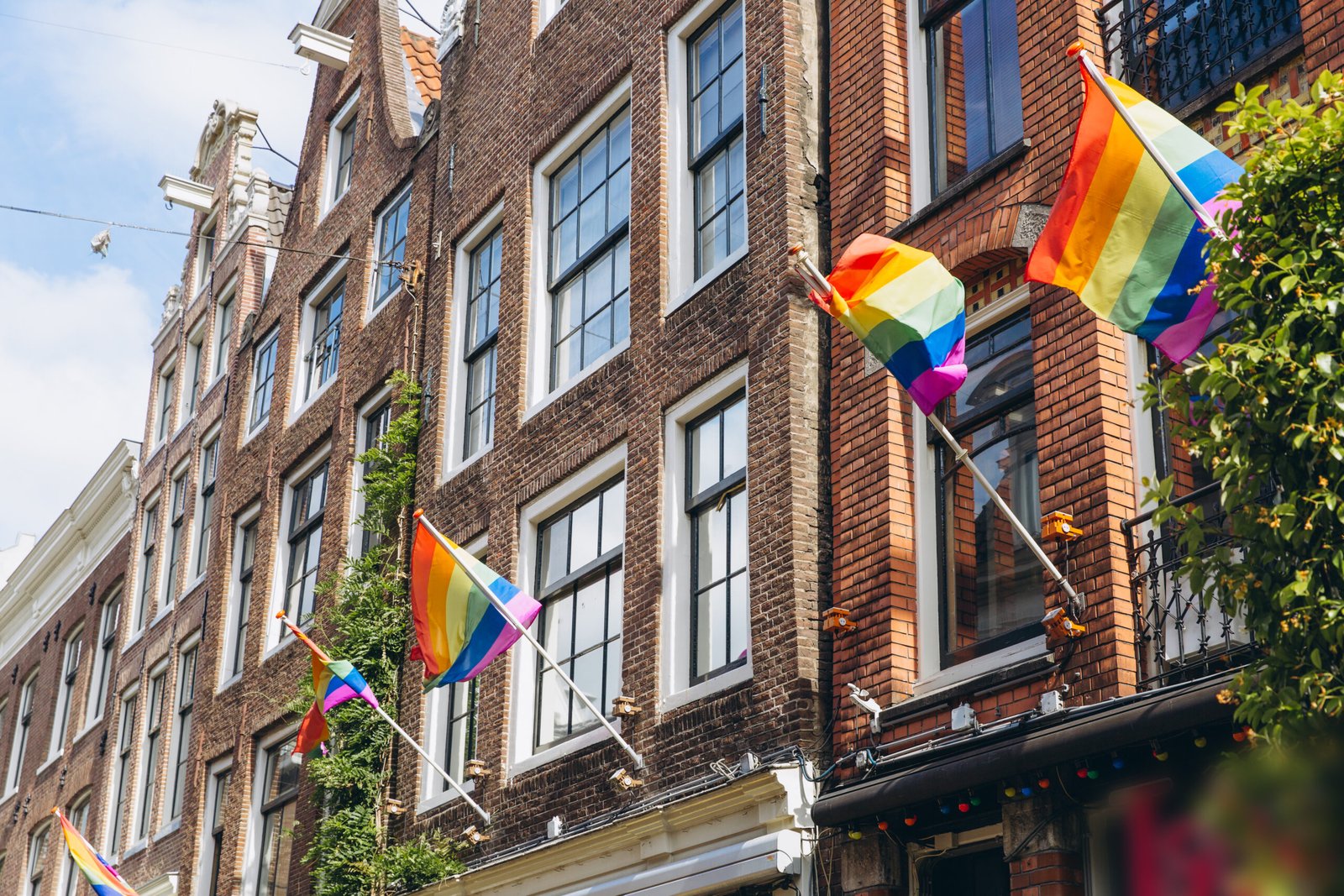
From 25 July to 8 August 2026, Amsterdam hosts what is shaping up to be the largest LGBTQ+ event in the world. Two weeks, over 300 events, a canal parade watched by 500,000 people, and a city that has spent the better part of two centuries earning the right to call itself a genuinely safe place to be queer.
Why Amsterdam, Why Now
The short answer: 25 years ago, on 1 April 2001, the Netherlands became the first country in the world to legalise same-sex marriage. On that morning, Amsterdam’s then-mayor Job Cohen married four couples in the city’s Stopera building. One of those couples, Gert Kasteel and Dolf Pasker, became internationally known when photos of their ceremony circulated worldwide. “Happy, very happy,” Kasteel told journalists. “Maybe a little nervous,” Pasker added.
Since that morning, more than 36,000 same-sex couples have married in the Netherlands, according to the country’s official statistics office. The 25th anniversary is the occasion WorldPride 2026 is built around. This is also Amsterdam’s first time hosting either WorldPride or EuroPride — and in 2026 it hosts both simultaneously, the first European city to do so since Madrid in 2017.
WorldPride is the global event licensed by InterPride and staged every two years in a different city. Previous hosts have included New York (2019), Copenhagen (2021), and Sydney (2023). Amsterdam 2026 is, by the numbers, the largest edition yet.
A Country That Got There First: Dutch LGBTQ+ History
The Netherlands’ record on LGBTQ+ rights is long, but not without serious interruptions.
1811. When Napoleon’s forces occupied the Netherlands and installed the French Penal Code, laws against same-sex activity between consenting adults were swept away. After the Dutch regained independence in 1813, they chose not to reinstate them. This made the Netherlands one of the earliest European countries to have no legal prohibition on homosexuality in private.
1730-1811 — the gap. Worth naming: before the French arrived, sodomy was a capital crime in the Dutch Republic, leading to waves of persecution. Between 1730 and 1811, hundreds of men were arrested, tortured, and executed. History isn’t clean.
1886-1911. A new penal code in 1886 didn’t re-criminalise homosexuality itself, but Christian parties pushed through Article 248bis in 1911, setting a discriminatory age of consent for same-sex activity at 21 while the heterosexual age of consent remained 16. The provision was based on the idea that young people could be “seduced” into homosexuality — a theory that was both harmful and, as the Dutch would eventually acknowledge, nonsense. The article remained in force for sixty years.
1940-1945. The Nazi occupation re-criminalised homosexuality under Paragraph 175, imported from German law. Gay men in occupied territories were arrested, and some were sent to concentration camps where they were forced to wear pink triangles — the inverted symbol now reclaimed as a badge of pride. In 1946, the Dutch writer Jef Last estimated in the magazine Levensrecht that roughly 40% of concentration camp prisoners had been homosexual, a figure that generated enormous controversy.
1946. COC Nederland was founded — originally as the Cultuur en Ontspannings Centrum (Culture and Recreation Centre), a deliberately vague name chosen because the organisation’s actual purpose had to be obscured for safety. It is now the world’s oldest continuously operating LGBTQ+ organisation, still active in Amsterdam today.
1971. After a student working group organised what became the Netherlands’ first gay demonstration in 1969, demanding the abolition of Article 248bis, parliament finally voted to remove the discriminatory age of consent provision. The age of consent became equal at 16 regardless of gender or sexual orientation.
1987. The Homomonument was unveiled on the bank of the Keizersgracht canal beside the Westerkerk. It was the world’s first memorial dedicated to gay and lesbian people persecuted during World War II. Its design — three pink granite triangles forming a larger triangle — directly references the symbols sewn onto victims’ uniforms in concentration camps. Each triangle points toward a different site: the National War Memorial on Dam Square, the Anne Frank House across the canal, and the former headquarters of COC Nederland. In 1970, gay activists had been arrested for placing a lavender wreath on the National War Memorial; the Homomonument was partly the long answer to that arrest.
1998. Pink Point opened as Amsterdam’s official LGBTQ+ information kiosk next to the Homomonument, staffed by volunteers and still operating today.
2001. The marriage equality law, passed in the Dutch parliament by 109 votes to 33 in the lower house and 49 to 26 in the upper house, was signed by Queen Beatrix on 21 December 2000 and came into force on 1 April 2001. Marriage, adoption rights, equal access — the package was comprehensive from day one.
2026. The Netherlands appointed its first openly gay prime minister, Rob Jetten, in February 2026. Not a symbolic gesture — he got there through coalition politics — but the timing, weeks before WorldPride, was not lost on anyone.
A Brief History of Pride in Amsterdam
Amsterdam Pride didn’t start with protest. It started as a party, and an unusual one at that.
The first Canal Parade took place on 3 August 1996, organised by Gay Business Amsterdam (GBA) as a prelude to the Gay Games coming to the city in 1998. The founder Siep de Haan is explicit about the origins: “Pride everywhere else in the world started from activism. But here it was a thank you to the city and its inhabitants.” Over 45 boats took part in that first parade; around 20,000 people watched from the canal banks.
By 1997, the number of spectators had tripled. The 1998 Gay Games brought 14,000 athletes and around 250,000 visitors to Amsterdam. The Canal Parade had become something the city didn’t want to stop doing.
Unlike every other major Pride in the world, Amsterdam’s central event takes place on water. The city’s 17th-century canal ring — a UNESCO World Heritage Site — becomes the parade route. There are no floats on roads, no municipal permits for street blockages in the usual sense. The boats navigate the Nieuwe Herengracht, the Amstel, and the Prinsengracht, while spectators pack every bridge, every canal bank, every café terrace with a view.
From 2000 to 2003, events on Reguliersdwarsstraat — the 200-metre stretch between Rembrandtplein and Muntplein that functions as the spine of Amsterdam’s gay nightlife — reached their loudest peak. In 2001, the year the Netherlands became the first country to legalise same-sex marriage, Kylie Minogue performed an unannounced street set on Reguliersdwarsstraat during Pride week. It remains one of the more celebrated moments in the event’s history.
In 2017, the event was renamed from Amsterdam Gay Pride to Pride Amsterdam, making official what the crowd had long reflected: this was not exclusively a gay men’s event, and it never really had been.
The 2026 edition is the thirty-first Canal Parade. It is also the first to add a 10,000-seat WorldPride Stadium on the Prinsengracht, through which the boats will sail on 1 August.
The Full Programme: What’s On and When
WorldPride Amsterdam 2026 runs from Saturday 25 July through Saturday 8 August. The first week is essentially Amsterdam Pride as it has always been; the second week expands into the full WorldPride format with international programming, the human rights conference, and the Museumplein village.
All official event information, the full programme, and ticket links are at pride.amsterdam/en/events.
Main Events at a Glance
| Date | Event | Time | Venue | Cost |
| Sat 25 July | Pride Walk (opening march) | 11:00–15:00 | Dam Square → Vondelpark | Free |
| Sat 25 July | Pride Park (Vondelpark opening festival) | 12:00–22:00 | Vondelpark | Free |
| Wed–Thu 29–30 July | Open Air Film Festival | 21:00–00:00 | Mercatorplein/Zuid | Free (400 seats) |
| Thu 30 July | Senior Pride Concert | 17:00–23:00 | Nieuwmarkt | Free |
| Fri–Sat 31 July–1 Aug | Street Parties (12+ venues across city) | 16:00–23:59 | City centre | Free |
| Sat 1 August | 🌈 Canal Parade | 12:00–18:00 | Prinsengracht / Amstel canals | Free to watch |
| Sun 2 August | Halfway There Party | 14:00–23:00 | Dam Square | Free |
| Tue 4 August | UNITY Concert (25,000 capacity) | 17:30–23:00 | Museumplein | Ticket required |
| Wed–Fri 5–7 August | Human Rights Conference | 09:00–17:00 | Beurs van Berlage | Ticket required |
| Wed–Sat 5–8 August | WorldPride Village | 12:00–23:00 (Fri/Sat to 23:59) | Museumplein | Free (daytime) |
| Thu 6 August | Wedding Party XXL (25th anniversary celebration) | 17:30–23:00 | Museumplein | Ticket required |
| Sat 8 August | WorldPride March (land-based parade) | 15:00–18:00 | Martin Luther King Park → Museumplein | Free |
| Sat 8 August | WorldPride Closing Concert | Evening | Museumplein | Ticket required |
Notes on the table: Ticket prices for the concerts had not been published in detail as of publication — the official site lists them as ticketed events with a 3-day pass option for the three Museumplein concerts (UNITY, Wedding Party XXL, Closing Concert). Check pride.amsterdam directly and book early; these will sell out. The Human Rights Conference at the Beurs van Berlage is expected to run roughly €0–50 depending on the session. Club nights and circuit parties across the city run €20–50 at the door, with well-known brands like WE Party from Madrid appearing.
The full programme also includes the Queer Amsterdam exhibition (running 9 July 2026 to 4 April 2027), the COC Shakespeare Club at the H’ART Museum, a Queer Market XXL at NDSM, a Pride Art Route, Youth Pride, Trans Pride, Bi+ Pride, Women+ Pride, and dozens of community events — including the Unicorn Boat Parade at Sloterplas on 10 July, a women’s event that opens the wider festival season.
The Canal Parade: What to Expect
The Canal Parade is the centrepiece, and on 1 August 2026 it gets its biggest staging yet.
The boats — around 80 or more, decorated with varying degrees of ambition, political messaging, and elaborate costumes — sail a route through the Prinsengracht, the Amstel, and the Keizersgracht. The parade runs from around 12:00 to 18:00. If you want a decent spot on the canal banks, arrive by 9am. The banks fill fast, and by the time the first boat appears, there will be half a million people along the route.
This year, a 10,000-seat WorldPride Stadium has been built on the Prinsengracht — the boats sail through it. The official site calls it “a once-in-a-lifetime experience for both the boats and the audience.” Given a 10,000-person stadium purpose-built for a boat to sail through, that reads as understatement.
Watching from the canal bank is free and requires no ticket. If you want to watch from your own private boat, you need a Pride Vignette, which will go on sale from 1 July 2026 via botenparade.nl — these are zone-specific and determine where along the route you can position your vessel.
Canal-side terrace spots at bars and restaurants along the Prinsengracht and Keizersgracht require advance booking and a food/drinks minimum spend. They sell out months in advance and are already largely gone.
The boats range from LGBTQ+ organisations and charities to corporate floats to political parties and embassies. Since 2001, the parade has included boats representing communities where homosexuality remains criminalised — Iran, some years; various African countries — which gives the celebration a sharper political edge underneath the music. In 2017, a Suicide Prevention Boat appeared alongside an Iranian-themed vessel, which sums up the range.
Where to Stay
Amsterdam’s hotels filled up fast for this. Data from the travel platform misterb&b showed bookings running 16% above comparable major-event years, and travellers planning to go found 70% of canal-adjacent accommodation already reserved as early as late 2025.
The canal belt — the Jordaan, the 9 Streets area, Rembrandtplein — puts you in the middle of everything for Pride week. If the city centre is sold out or too expensive, Rotterdam (30 minutes by train) and Haarlem (20 minutes) are both workable bases. Budget an average of two to three times normal Amsterdam nightly rates for the peak Pride period.
Practical Information
Costs. The Pride Walk, Pride Park, Open Air Film Festival, Senior Pride Concert, Street Parties, Canal Parade, Halfway There Party, and WorldPride Village are all free. The Unity Concert, Human Rights Conference, Wedding Party XXL, and Closing Concert require tickets. The three Museumplein concerts are available individually or as a 3-day pass.
Getting there. Amsterdam Centraal connects to international trains and Eurostar services. Schiphol Airport is 15 minutes from the city centre by direct train.
Getting around. The tram network covers most of the canal belt. During the Canal Parade on 1 August, certain canal-side routes will be closed and public transport altered — check gvb.nl for updated routes closer to the date.
The nightlife hub. Most of Amsterdam’s gay bars have become, well, bars. The Dutch don’t see the need to segment people anymore. Reguliersdwarsstraat is the main gay entertainment strip — a short walk from Rembrandtplein, with 15+ venues in under 200 metres. It feels a bit ghettoy. A nice ghetto, but cordoned off. The Warmoesstraat in the Red Light District has a different character (leather bars, fetish venues). The Zeedijk has been part of Amsterdam’s gay scene for decades and is quieter in tone. The Queens Head Pub (which will become your favorite gay bar in the world) and Café ‘t Mandje (a historic bar from 1927 that was open during Nazi occupation)
Safety. Amsterdam is one of the most LGBTQ+-friendly cities in Europe in daily life, not just during Pride. Public displays of affection are broadly accepted. As with any major outdoor event at this scale, stay aware of your belongings and your surroundings in crowd situations. The biggest issue is usually drunk visitors who treat Amsterdam as some sort of release escape hatch. The event organisers note that public urination carries a €140 fine — toilet locations are mapped on the official site.
Accessibility. Event pages on pride.amsterdam include accessibility information per event, including mobility options and sensory warnings.
The official website. All ticket links, the complete and up-to-date programme, venue maps, and practical visitor information: pride.amsterdam/en.
Why It Still Matters
There is a recurring question inside Amsterdam Pride — and particularly ahead of prides everywhere and a WorldPride at this scale — about what exactly the event is for. Is it a party? A protest? Tourism infrastructure dressed up as politics?
The iamsterdam history page puts the stakes plainly: “Equal and hard-won rights are under pressure in many places.” Homosexuality remains criminalised in 65 countries. In some, it still carries the death penalty. The same week that Amsterdam is hosting the world’s biggest Pride, there will be countries where being photographed at it could get someone arrested when they return home.
The boats from those countries have been sailing in the Canal Parade for years. In 2026, the presence of those delegations — not as tourists, but as people for whom the parade is genuinely an act of courage — will be more visible than ever.
At the same time, 25 years of legal marriage in the Netherlands means something. On 1 April 2026, three more couples married at Amsterdam City Hall at midnight, conducted by the current mayor Femke Halsema. The occasion, she said, was about celebrating what had been won while refusing to take it for granted.
Since 2001, more than 36,000 same-sex couples have married in the Netherlands. The country that got there first — a country with a complicated history of its own, which ran persecution alongside tolerance for centuries — is marking the anniversary the only way Amsterdam really knows how: by flooding the canals and turning up the music.
Sources and Further Reading
- Official WorldPride Amsterdam 2026 programme — pride.amsterdam
- Full events calendar — pride.amsterdam/en/events
- LGBTQ+ History and Milestones in Amsterdam — iamsterdam.com
- History of the Amsterdam Canal Parade — lovers.nl
- A History of Amsterdam Pride — iamexpat.nl
- Key Moments in Dutch LGBTQ+ History — dutchnews.nl
- LGBTQ Rights in the Netherlands — Wikipedia
- The Homomonument — iamsterdam.com
- 25 Years of Same-Sex Marriage — Associated Press/AOL
- Pride Amsterdam: Progress and Scrutiny — iamsterdam.com
- WorldPride Amsterdam 2026 Travel Guide — pridelatitude.com